Check out our online store!

Tanks
AST (Aboveground Storage Tank — A tank installed above ground level, typically constructed of steel, used to store flammable or combustible liquids.
Double-Wall Tank — A tank constructed with both an inner primary tank and an outer secondary tank, creating an interstitial space (interstice) for monitoring and containment. UL 142–listed and often required by regulators in lieu of single-wall tanks with external containment.
Dual-Compartment Tank — A storage tank with a single outer shell internally partitioned by bulkhead(s) to create two independent product compartments. Commonly UL 142–listed; each compartment requires its own fill, venting, gauging, overfill prevention, and labeling.
STI F921® — A UL 142–listed double-wall aboveground steel tank that incorporates an interstitial space for leak detection and containment. Available with a 30 year warranty.
STI Fireguard® — A UL 2085–listed insulated double wall aboveground steel storage tank providing 2-hour fire protection. The 3 or 6 inch gap between the inner and outer shell is filled with a cementitious dry-setting material. Available with a 30 year warranty.
STI Flameshield® — A UL 142–listed aboveground double wall steel storage tank with secondary containment that has been fire tested to ensure it would remain structurally intact.
STI GenTank® — A UL 142–listed aboveground steel storage tank manufactured in single- or double-wall configurations. Supports generator weight while providing integral fuel storage with secondary containment, leak detection, and fittings for supply, return, and venting.
Horizontal Cylindrical Tank — A shop-fabricated cylindrical steel tank with its axis horizontal. Typically supported on skids, saddles, or in some cases beam legs on the heads.
Non-UL Tank — A steel storage tank not constructed or tested in accordance with UL standards.
Rectangular Tank — A shop-fabricated steel tank with flat rectangular sides, top, and bottom. Often UL 142–listed; used where low profile or space constraints favor a box form (e.g., generator base tanks, skids, indoor rooms).
Single-Wall Tank — An aboveground storage tank constructed with only one layer of steel that serves as primary containment. Requires external secondary containment (e.g., dikes, berms, spill basins) and is built in accordance with UL 142 or API 650 standards.
UL 80 — Underwriters Laboratories Standard 80—construction requirements for residential and commercial heating oil tanks. Often called “basement tanks” their obround shape allows them to fit through interior doorways.
UL 142 — Underwriters Laboratories Standard 142—design, construction, and testing requirements for steel aboveground storage tanks for flammable and combustible liquids.
UL 2085 — Underwriters Laboratories Standard 2085—construction requirements for protected aboveground tanks, including fire resistance, impact resistance, and secondary containment.
Vertical Cylindrical Tank — A cylindrical steel tank with its axis vertical. Produced as shop-fabricated UL 142 tanks (smaller capacities) or field-erected per API 650/620 for large volumes; efficient land use and common in terminals and bulk storage.
Vertical Tank on Legs — Cylindrical tanks with either a cone bottom or dished bottom. These tanks are preferred over vertical flat bottom tanks when 100% drainage is necessary. Beam or angle legs are often the supports, and they come in either single or double wall configurations. At STAFCO, all Vertical Tanks on Legs are built to UL-142.
UST (Underground Storage Tank) — A tank system with at least 10% of its volume underground; regulated separately under federal and state law.
Tank Components
Cone Roof — A common AST design featuring a fixed conical roof welded to the shell. Economical, durable, and widely used for petroleum and chemical storage.
Water Drain — A small tank fitting as close to the bottom as possible to drain water out of the tank. Most combustible liquids and oils are lighter than water, so water will rest at the bottom of the tank.
Emergency vent provision — A tank opening that is sized in proportion to the tank volume or wetted surface area of a tank. Emergency vent provisions are mandatory for all UL-142 tanks.
Fittings — Also referred to as bungs, flanges, openings, or nozzles. Often, but not always threaded or flanged.
Gasket — A compressible sealing element placed between mating surfaces (e.g., flanged nozzles, manway covers, gauge hatches) to create a leak-tight joint. Selected for chemical compatibility and temperature; common materials include nitrile/Buna-N, FKM (Viton®), EPDM, PTFE, graphite, and vegetable fiber.
Grounding Tabs/Grounding Lug — Designed per NFPA 30 this provides a means of electrically grounding the tank.
Head — Nearly every tank head is either flat-flanged, flanged and dished, dished only, cone or chime.
Hydrostatic Testing — A method of testing a tank or piping system by filling it with water or another liquid under pressure to check for leaks or structural integrity.
Interstitial monitoring pipe — A vertical pipe welded to the secondary shel with its termination above the maximum liquid level. Used for leak detection.
Inspection Hatch — A smaller access port than a manway, usually 4–8 inches in diameter, for inserting gauges, probes, or cameras without opening a full manway.
Interstice — The monitored space between the inner and outer walls of a double-wall tank. It may be filled with air, vacuum, or liquid and is monitored with sensors or gauges to detect leaks from either wall.
Manway — A large circular access opening on the top or side of a tank, typically 18–24 inches in diameter, allowing entry for inspection, cleaning, maintenance, or repairs. Sealed with bolted covers when not in use.
Ladder and Platform Assembly — A permanent or temporary access structure attached to or placed near a storage tank to allow safe inspection, gauging, and maintenance. Must meet OSHA fall-protection requirements.
Strike Plate — A flat steel plate inside the tank bottom beneath the fill tube or gauging opening, protecting the shell from wear, puncture, or erosion.
Tank Lining — An internal coating applied to steel tank surfaces to prevent corrosion and extend service life, typically epoxy- or polyurethane-based.
Secondary Containment — A method of containing leaks or spills from the primary tank, such as a double-wall design, dike, or berm.
Tank Tightness Test (leak test, pressure test) — A pressure- or vacuum-based test on a tank and piping system to determine if leaks are present, often required by regulators to verify integrity.
Equipment
Anti-Siphon Valve — A valve installed in product piping that automatically closes when flow exceeds normal operating conditions, such as during a line rupture. It prevents uncontrolled siphoning of liquid from a tank into the environment.
Automatic Shut-Off Nozzle — A dispensing nozzle with an internal sensing port (Venturi vacuum) in the spout that automatically closes the valve when rising product covers the spout or normal airflow is interrupted. Prevents overfills and is common at retail fueling.
Breakaway — A safety coupling installed in the dispenser hose that separates at a preset pull force (e.g., a drive-off). Internal check valves on both sides close upon separation to minimize spillage and protect the dispenser and piping from damage.
Clock Gauge — A float-operated mechanical gauge used on aboveground or underground storage tanks to measure liquid level. The float’s vertical movement is converted to a dial (clock-style) display, providing an easy-to-read indication without electronic power.
Drop Tube — A vertical pipe installed inside the fill connection of a tank, extending close to the bottom. It directs incoming product downward during filling, reducing static electricity, splashing, and vapor generation.
Electronic Tank Gauge — A digital monitoring system (e.g., Morrison Bros. FIG 1218) that uses a mechanical float sensor to electronically display liquid level or volume for up to four aboveground tanks, with console, alarms, and network connectivity.
Emergency Vent — Pressure-relief devices designed to vent vapors or product during abnormal conditions such as fire exposure. The combustion is directed out of the emergency vent to prevent weld seams from failing.
Flame Arrester — A safety device installed in tank venting systems that prevents external flames from entering and igniting flammable vapors inside the tank.
Fire Valve/ Fusible Link — A heat-sensitive safety element designed to melt at a specific temperature, triggering automatic closure of a valve or release of a mechanism. Common in emergency shutoff systems near ASTs.
High-Level Alarm — A safety device that provides an audible and/or visual warning when the liquid level reaches a predetermined high point, allowing time to stop product transfer before maximum safe fill.
Leak Detection Gauge — Technology such as sensors, interstitial monitoring, or manual gauging used to detect leaks from storage tanks.
Manual Nozzle — A hand-operated dispensing nozzle without automatic shut-off. Flow continues while the lever is squeezed; used where constant attendance is maintained and overfill prevention is managed by procedure or external devices.
Normal Vent — Also called a Working Vent. Tank venting designed to manage ordinary pressure fluctuations during filling, withdrawal, or thermal expansion. This must be installed and properly maintained to prevent tank explosion or implosion during filling/drawing.
Overfill Prevention Device — A device such as a shutoff valve, alarm, or flow restrictor designed to prevent tank overfilling during product transfer.
Pressure/Vacuum Vent — A specialized tank vent that opens only when internal pressure or vacuum exceeds set limits, reducing vapor emissions, preventing tank implosion, and maintaining structural integrity during thermal changes or transfer.
Quick Coupling — A fitting that allows hoses or pipes to be connected and disconnected rapidly. Often required to receive bulk filling.
Swivel — A rotating hose fitting between the hose and the nozzle (or within the hose run) that allows free rotation, reducing kinking and stress on fittings.
Spill Containment (Spill Box / Spill Bucket) — A catchment system at a tank fill connection to capture small releases during filling.
Submersible Pump (STP) — A motor-driven pump installed inside the tank that pushes product to dispensers. Provides higher flow rates and longer-distance transfer than suction systems; common in retail fueling.
Vapor Recovery System — A system that captures and controls vapors released during tank filling or dispensing.
Water Draw-Off Valve — A valve at the lowest point of a tank used to drain accumulated water, preventing corrosion and maintaining fuel quality.
Whistle Vent (Fill Alarm) — A venting device that starts producing a whistling sound at a given liquid level indicating to the operator to stop filling the tank.
Other Terms
API 650 — American Petroleum Institute standard for the design and construction of welded aboveground steel storage tanks for oil and other liquids. These tanks are too large to be produced in a shop and are instead built on-site or “field erected.”
Bollard — A sturdy vertical post installed near ASTs or dispensers to protect tanks and equipment from vehicle impact.
Cathodic Protection — A technique that uses electrical current or sacrificial anodes to prevent corrosion of a steel tank.
Dike / Berm — An embankment or containment wall constructed around a storage tank to contain spills or leaks.
Fire Marshal — A county or state official responsible for reviewing, permitting, and inspecting storage tank installations for compliance with fire codes. In the United States, the local fire marshal is typically the most authoritative resource for your tank project.
Gravel Ring — A circular steel ring filled with gravel designed to support vertical ASTs, distributing load, minimizing settlement, and providing a stable base.
Impervious Liner — A non-porous barrier (concrete, synthetic, or clay) used under tanks or containment areas to prevent seepage into the ground.
Maximum Liquid Level (Safe Fill Height) — The maximum level to which a tank may be filled without risking overflow, thermal expansion, or system failure.
NFPA (National Fire Protection Association) — International nonprofit organization that develops fire codes and standards widely adopted by states and municipalities.
NFPA 30 (Flammable and Combustible Liquids Code) — Standard covering the storage, handling, and use of flammable and combustible liquids, including AST design and installation requirements.
Normal Liquid Level — The standard operating level of liquid in a tank, below maximum capacity.
Off-Road Diesel (Dyed Diesel / Red Diesel) — Diesel for non-highway uses (e.g., construction equipment, agriculture, generators). Dyed red for tax-exempt status; illegal on public roads. Since 2014, nonroad/locomotive/marine diesel is also ULSD (15 ppm sulfur) under EPA rules.
On-Road Diesel (Highway Diesel) — Clear, tax-paid diesel for vehicles on public roads; in the U.S., must be ULSD (15 ppm sulfur) per EPA rules.
Spill Prevention, Control, and Countermeasure (SPCC) Plan — An EPA-required plan for facilities storing large volumes of oil, detailing spill prevention and emergency response measures.
Tank Farm — A facility or area where multiple ASTs are installed and operated, typically requiring fire separation and spill control planning.
ULC S601 — Canadian safety standard for shop-fabricated steel aboveground tanks for flammable and combustible liquids, often referenced in cross-border contexts.
IBC (International Building Code) — Model building code that sets construction and safety requirements, including fire-resistance provisions.
IFC (International Fire Code) — Model fire code that regulates fire safety, hazardous materials storage, and fuel storage tanks.
STI (Steel Tank Institute) — Industry organization that develops consensus standards and certifications for tank construction, including Fireguard® and F921® designs.
Tank Appurtenances — The valves, gauges, vents, manways, pumps, and other fittings attached to a storage tank that support operation and safety.
Tank Pad / Tank Foundation — A prepared base (often concrete) on which a storage tank is installed, providing stability and preventing settling.
WHY CHOOSE STAFCO

Quality Customer Service
As a smaller shop, we offer the personal attention and flexibility to meet your specific needs. Every project gets one-on-one support.

Certified to Build Your Design
We’re certified to manufacture aboveground storage tanks (AST) that meet UL, STI, and EPA standards with custom options available.

Made in the USA
Our tanks are proudly built in America using U.S.-sourced steel and materials, for consistent quality and reliable delivery. Yes, we deliver!
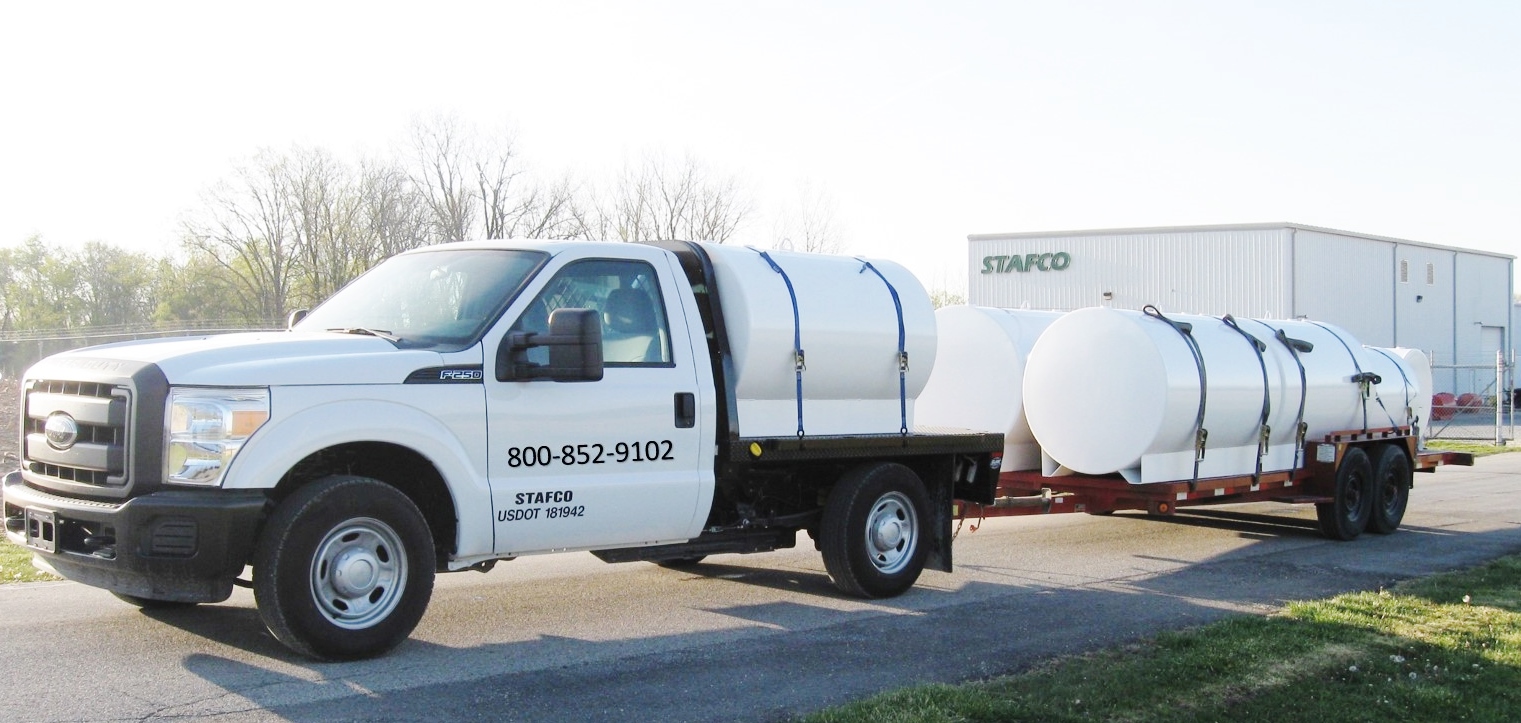
Need a smaller size tank? Inquire about low-cost factory delivery!
Local rates | Reliable freight partners | Commercial shipping nationwide